10.26.2012

A Dabawallah Day

It was 10:30am and already the air was a thick urban stew of sweat, exhaust, and the smell of stuff being fried in Mumbai’s ubiquitous food stalls. Zach and I were huddled in a foot-wide slice of shade, sipping tiny cups of 5 rupee chai. We had strategically positioned ourselves at a corner, where two exits from Churchgate Station opened out onto the sidewalk. Though it was well past rush hour, a steady stream of commuters hurried in and out of the station and trains pulled in and unloaded every few minutes.

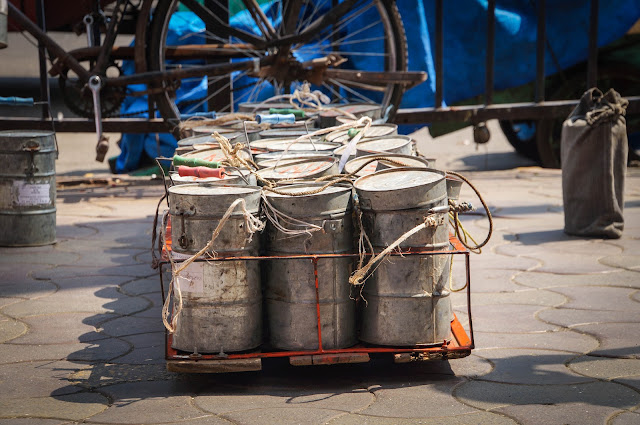
“There’s one!” shouted Zach, pointing over the heads of the crowd. Following his finger, I saw a man carrying a huge tray on his head. It was filled with homemade lunches: his and his colleagues’ lifebread.

Every day, thousands of Mumbai office workers make the long commute from the suburbs to downtown. Over the course of the morning, thousands of dabawallahs (literally, “box carriers”)  follow in their footsteps. Each dabawallah has a pick-up route in the suburbs, where they go from house to house collecting lunches made by wives or mothers. They ride into the city with the lunches from their neighborhood, stopping at various points along the way to sort and exchange with other dabawallahs. Each tiffin (as the multi-leveled tin containers are called) changes hands four or five times.  By 12:30pm, office workers all over Mumbai are eating lovingly-prepared dal and chapati at their desk and at the end of the day, the empty containers are delivered back to their respective homes. Collectively, about 5,000 dabawallahs deliver 200,000 lunches per day. Here’s the crazy thing: there is no technology involved. No computers, no cell phones, no cars, not even paper. The dabawallahs are mostly illiterate and make their deliveries using bicycles, wooden carts and huge trays carried on their heads. Each lunchbox has a code that explains what train stop it needs to get off at and its final destination. In 2002, Forbes magazine declared the dabbawallas a “six sigma” business, which means they operate at 99.9% efficiency. They make less than one mistake in six million deliveries (Wikipedia).

Zach had heard about dabawallahs at a presentation given at Google and was eager to see them in action, which is how we ended up skulking around the train station, asking security guards when they thought the dabawallahs might show up. The guards seems puzzled by our interest, but politely told us to wait by platform one. And they came. Watching them sort in the middle of the Mumbai’s mad sidewalks, it seemed impossible that this system could work, and as efficiently as it does. But, as we’ve been told so many times, “In India, everything is possible.”


(all photos by Heather!)


10.19.2012

Good Eats Part I: North India Round-up

Some of you have expressed surprise that, given the number of meals lovingly photographed by Zach and given the amount of time Heather spends talking about, reading about, and cooking Asian food, we haven't devoted any blog space to it. Well, let the feast begin! We've been travelling in one of the world's best places to eat and it has been glorious. Below, a round up of some of our foodie highlights so far. We included links to websites and address information whenever possible so that any of you heading to the Subcontinent soon can chew the same path across the nation. (Note: Sometimes we didn't agree. What? Married people don't agree?!)

Best Breakfast:
Chole Batura at Hotel Kabli, Delhi. The hotel serves food from a local restaurant to your room, allowing you to eat your Chole the way it was meant to be eaten... in your underwear!

Best Bread:
Hers: Afghani Naan straight from the oven in the Jangpura Bazaar, Delhi
His: Aloo paratha we made during cooking lesson with Meenu at Queen's Cafe, Udaipur. (Side note: Queen's Cafe other food is also insanely delicious. Don't miss the pumpkin curry with coconut/mint spice mix.)

Making chapati with Meenu's daughter 


Best Bang For Your $1.80:
All-you-can-eat thali at Natraj, Udaipur. It included eleven seperate and permanently refillable items: dal, potato, two curries, curd, chutney, sliced onions, papad, chapati, rice, mango pickle and chili sauce. Galub jamun for desert.

Thali at Natraj

Best chai:
The pot Himat cooked up for us under a tree in the desert outside of Jaislamer. And made with fresh sheep's milk, so Zach could drink it!

A nice spot for chai

Best Dosa:
Special Dosa, filled with dried fruit, nuts and coconut flakes at Ayyar's, Varanasi. This hole in the wall place was opened by the current owner's grandfather.

One of the owners of Ayyar's with a portrait of his grandfather

Best Snack: 
Hers: Mango ice pop (available pretty much everywhere)
His: Samosa (or three) at Madhur Milan, Varanasi

Best Extremely Local Food:
Hers: Ker Sangri, a desert bean served up at Desert Boy's Dhani in Jaisalmer
His: Mirchi bada, a hot pepper stuffed with potatoes and onions and then fried like a samosa, at Shahi's Somasas in Jodphur (Nai Sarak, left side just before main gate to Sardar Market).

Best dessert:
Hers: Khir, a milk and rice pudding at Crystal, a wonderful Punjabi spot across the street from Chowpatty Beach, Mumbai.
His: Grandma's homemade milk candy at Vijay and Sonam's house in Agra

Heather's Overall Favorite: 
Bhaghain Barta, a wickedly delicious egglant dish that has the deep smoky flavor of roasted eggplant with the brightness of tomato and heat of curry spices. Also at Crystal, Mumbai.

Zach's Overall Favorite: 
Vegetable pulao, eaten with dinner our first night in Delhi at Hotel Kabli. Objectively speaking, it may not be the best best thing we've eaten, but at the time it was the best Indian dish I'd ever had. We've tried many pulaos since then, and none compare.

If any of you have great India eats -- from favorite dishes to hole-in-the-wall restaurants (especially in Kerala where we're headed next) -- please comment!

10.15.2012

Desert Portraits

"She wants to invite you for chai," Prim, our camel driver, told us.

"Jip jip jip," we said, signalling to the camels that they should sit down so we could dismount. We've been invited into people's homes for chai all over India. Our record number of cups in a day so far is seven, consumed in five different places. The refrain-- "You must come to my home for tea!"-- is a testament to a tradition of hospitality that seems to transcend the class, caste, and religious boundaries which can prove so formidable in other contexts.

But this invitation was different. Prim's grandmother (actually his great aunt, but it's not a distinction they make here) had gestured us into her hut, grass-roofed and constructed from a mixture of sand, rock and cow dung. She gathered wood, started a fire, milked a sheep (!) and cooked up an incredibly tasty cup. We lingered for the rest of the afternoon as people came and went. A woman from a nearby village came by with her young son seeking a glass of water. She took one look at Prim making chapatis and told him to scram, taking full charge of the process. Prim's grandfather wandered in from tending the flocks, ate, and went out again into the fierce mid-afternoon sun. Two gypsy kids came by to gawk at the foreigners. We ate lunch in waves -- foreigners first, then men, then women. And we suddenly understood why we'd been sent into the desert with enormous quantities of vegetables, fruit and flour: every meal fed not only us, but whoever else happened to be near by.

It's a hard life, living in the desert. We were amazed by the creativity and resourcefulness we witnessed; that people with such limited resources transformed the harsh environment into a livable, even beautiful, place. There were farms everywhere -- talk about making the desert bloom. Himat, the driver who took us back and forth from Jaisalmer, offered the most eloquent testimony to his love of his home. Though he has all the advantages of city life and income now, he comes out to the desert whenever he can to enjoy the open air, the shade of a tree, the desert quiet.

We hope the portraits below honor the people we met, their spirit and resilience.


And for your continued viewing pleasure, here's the full set of photos from the desert. Thanks for all the great comments and feedback so far!

10.13.2012

India Photos: Our first 2 weeks

A highlights reel from our first few weeks in India:
https://plus.google.com/photos/102311875004581334954/albums/5798479016465443361?authkey=CPCcjPv8xovSzgE

And I have to admit: we are having a great time taking photos here. So many interesting people and beautiful things to work with. It's like a crazy playground for making still images. Hopefully some of these capture the essence of our adventures and the spirit of the people we've met. To my photographer friends: I am learning (slowly) how to use my camera, but any tips/advice/pointers is greatly appreciated.

And many of the photos have captions again -- click any photo to start a slideshow and then click the "expand <- ->" button in the bottom right corner to see large photos with captions.

10.12.2012

This is India

Hello from the edge of the Thar Desert!

We're writing from the turret of a fort in Jaisalmer, on the western edge of Rajasthan about 200km from Pakistan. While we were catching you all up on our Nepalese adventures, we've been traipsing around India. Our itinerary thus far? Delhi>Varanasi>Agra>Jodphur>Jaisalmer. We just returned from a wonderful two-night, three-day camel safari in the desert. We're hoping that after this post and one about our safari, we'll be all caught up and will be able to report in something closer to real time. We'll upload our photos from these fascinating cities (including the Taj Mahal!) as soon as we have better internet access.

On our first night in Delhi, we took a walk in the local bazaar, just a couple of blocks from our hotel in a small, non-touristy neighborhood called Jangpura. After the simplicty of our life on the Annapurna trail and the limited scope of Nepal's depressed economy, we were stunned by the liveliness of the neighborhood. At 8:30pm it was buzzing. People were out buying all manner of goods, street-side snack stalls were doing a swift business in samosas and laddos, and pedestrians, cycle rickshaws, and motorbikes all vied for space on the roadway. We watched Afghani naan being made in a clay oven, admired a tiny cooking-pot repair stand and marvelled at the number of fruit and veggie hawkers. In those first few hours, we were in love. India felt so alive and dynamic. We reveled in luxuries that we would normally take for granted: consistent electricity! Refrigeration! A/C! Western toilets! We heart India!

Within a few days, we'd also experienced some of the things that make India's cities tough places to travel: chaotic traffic, persistent touts, and everywhere evidence of the brutality of poverty. Within a couple of blocks of a Sufi shrine where devout Muslims are likely to fulfill their religious obligation to give alms, Zach and I saw more people with crippling deformities and diseases than we'd probably seen in the rest of our lives. We walked passed ten-year olds doing hard drugs on the sidewalk of Delhi at midday. We learned that anyone who approaches you on the street and says, "I don't want money, I just want to share my city's history" definitely wants your money.

But every moment of frustration or exhaustion has been richly rewarded. Our first two weeks in India were full of surprises, the kind of surprises that remind you to remain open to the kindness of strangers and to lean into the unfamiliar.

Here are a few of those strange and wonderful moments:

Street in Old Delhi at sunset

The Traffic Jam: 
Our second evening in Delhi, we caught a cycle rickshaw just as the sun was setting. We were on our way to the New Delhi train station to reserve some tickets. On the way, we soon got caught in a massive -- and I mean massive -- cycle rickshaw traffic jam.  For blocks and blocks, at a complete standstill, all we could see were cycle rickshaws, hand-pulled carts piled high with bags of cement or sugar, even a few horse-pulled wagons. After sitting at a standstill for about fifteen minutes, we realized that we weren't going to go anywhere anytime soon.  Unfortunately, we had no idea where we were or how far we were from the train station. We abandoned our rickshaw and, in the dark, with a growing stream of pedestrians, began to pick our way across the traffic jam, literally climbing over bike wheels and loads of cement. We saw a blind man being passed hand-to-hand, from rickshaw driver to rickshaw driver. Being the only tourists as far as the eye could see in a neighborhood we didn't know and in the dark, we were trying hard to be inconspicuous. When we got to an intersection a few blocks up, we discovered that the jam was caused by two massive trucks parked in the middle of a four-way intersection, blaring music and campaign messages. They were both full of children- probably thirty in a truck bed-- in elaborate bejewelled traditional costume. As we walked around the trucks, heads down,  the kids spotted us. The trucks erupted in a chorus of English and sixty little hands reached for ours.  "Hello! Hello! Where are you from? Pen? Picture? Hello!" It was a touching moment of celebrity, even though it totally blew our cover.


The Holy Man: 
One evening in Varanasi, we decided to wander the streets of the old town, since it had finally cooled off a bit. We found ourselves at a quiet ghat (set of stairs) and sat down to watch the Ganges roll by. A few feet away was a sadhu, a holy man, wrapped in orange with a massive beard and long, dreadlocked hair. He and Zach got to talking about how he, Baba Somanth, ended up becoming a holy man and exactly what a holy man does each day. (Prays, walks, writes.) About fifteen minutes in, he pulled out a pipe and offered it to Zach. "Ganga"? Since Ganga is also the name of Ganges in Hindu, it took Zach a minute to figure out what was going on. We sat together for awhile, then eventually wandered away, leaving him to puff and pray in the fading light. (The picture was taken the next morning when we ran into him coming out of a temple in another part of the city.)


Vijay and Sonam: 
We were on the train to Agra, probably about half an hour into the journey, when a woman entered our compartment and started clapping. The couple sitting across from us gave her a few rupees. I was looking at her and trying to figure out just what was different when the guy across from us leaned across the aisle and offered an explanation. "She is... I don't know the word in English."
"Transgender?" I offered.
"Yes," he replied. He told us all about the community of hijras in India, and how they are marginalized, and so form their own "families" amongst themselves. We ended up chatting with Vijay and his wife, Sonam, for the next two hours. They were on their way back from Delhi, where Sonam, who has Lupus, had a doctor's appointment. Just before we arrived in Agra, they consulted privately for a minute and then Vijay turned to us and said, "My wife and I would like you to come and stay with us at home." We already had reserved a room at a guesthouse and had a driver picking us up at the train station, but were able to convince the driver to detour with us to visit their home on the way. They served us chai and homemade sweets and introduced us to their two vivacious daughers, Angel, 6 and Annie, 14 months. Their home was modest, three rooms in total, and they already had Sonam's sister and brother visiting. But they were absolutely sincere in their offer and in the pleasure they took spending time with us. We were amazed by their hospitality and generosity.


G-O-D: One night in Jodphur,we decided to go to a Bollywood movie (English Vinglish, which was excellent and fully understandable even without speaking Hindi, check it out!) and we caught an auto-rickshaw home. As the driver wound his way through the narrow streets of the old city, he casually leaned back and started this conversation:
Driver: "Do you know God?"
Zach: "What?"
Driver: "God. Do you know God?"
Zach: "God?"
Driver: "No, not gad, God. G-O-D."
Zach: "No, I don't. What is God's name?"
Driver: "Aryana."
Zach: "Who? Do you mean Shiva?" (It was hard to hear over the noise of the engine.)
Driver: "No, Aryana. I go to see God. On the eleven."
Zach: "Wow. Where? Where does God live?"
Driver: "Delhi. If you see this god, you will believe, 100%!"
Zach: "..."
Driver: "I go on the eleven. Will you come with me?"
Zach: "....". Followed by polite but firm "No."
Driver: "................"
Zach: "But... thank you. Does this god have a website?"
Driver: "Yes. www.jagatgururampaljimaharaj.com"
Zach: (In disbelief) "What? Can you repeat that?"
Driver: (slowly)  "w w w dot ja gat guru rampaljimaharaj dot com"
Zach: "Oh. Okay, I will look him up."
Driver: "Yes. You will see. You will believe. 100%."

10.05.2012

If there's a festival...

'You should stay! There will be a festival tonight. The lamas will dance. I think it will be very interesting for you," Sirush said. Zach and I eyed each other. We were eating at the small Dakar Lodge in the village of Lupra, a two hour hike from anywhere. We had only planned to  stop for lunch. Also, we were definitely the only tourists coming through today; there hadn't been a soul in either direction on the hike in. Our cynicism kicked in: was this a ploy?

"We'll think about it," we replied. We put on our packs and started to head out of the village, passing the bright red gompa on the way. There were lots of people around: lamas in their red skirts, women making tea. The place was bustling. As we peeked through the doorway, we were gestured inside. From the ceiling hung one big mask and several others wrapped in rough brown cloth. "For the festival?" we asked. Yes, they explained. The lamas would wear different masks and dance.

We headed right back to the lodge: "We'll stay!"

Lupra
We learned that the festival is called Dogbay, is part of the Bon religion, and is the biggest event in the town all year. Bon is the indigenous religion of Tibet, which pre-dates Buddhism. Bon's rituals, at least to our eyes, are strongly blended with those of Mahayana Buddhism but have retained lots of animist and folkloric elements. There are only two villages in Mustang with Bon gompas; some Bon practitioners from nearby towns had walked hours just to be at the festival. Interestingly, Lupra has no monks; the rituals are lead by married "householder lamas." Sirush's father is one of them and was busy at the gompa all afternoon, making preparations.

With hours to spare before the festival started, Sirush, in his shy, eager way, offered to take us on a village tour. He walked us up, up, up on narrow winding paths through patches of buckwheat and small orchards. Lupra is tiny; it has 16 families and is built into the side of canyon. Across the canyon, natural caves dot the cliff. Before the town was founded, wandering ascetics would sit in the caves and meditate. On the way up, Sirush kept telling us he was taking us to the "hostel." We couldn't figure out what he was talking about-- his was clearly the only lodge in town. As we came over the hill, we saw a yard full of kids. It was a school!

We spent a wonderful afternoon at the school, watching classes, drinking tea with the kids, teaching songs and counting to the youngest ones and talking with Norbu, the circumspect and motivated Tibetan monk who runs the school. The students range from ages 3-14 and all live at the hostel; for some, their home villages are 2-3 days' walk away. Norbu told us that sometimes he gets children whose parents are nomadic herders in Upper Mustang, a very remote region on the border with Tibet. The school provides  them with clothes, because they usually have nothing but some animal skin wrappings.

Counting practice

Norbu runs a tight and effective insitution. 83 kids live together, learn together, and speak, read and write in Nepali, English, and Tibetan (their home language). Norbu's goal is to provide education that grounds the kids in their culture and language while also providing them with the tools they need to advance in the modern world. The young students are eager and the older students are amazing: they speak fluent English, teach the younger kids, and showed us science textbooks that would intimidate an American high schooler. Soon enough the sun had begun to set, and we headed down the hill, promising the students we'd see them at the festival. (Interested in supporting the kids' reading habits? See the end of the post!)

The entire village crowded into the gompa that night. Old women, young women with their babies in arms, nearly all of the children from the school. We were ushered into a corner and served Tibetan tea (tea with butter and salt). Since Zach can't digest lactose, he discreetely emptied his tea into my own glass, and I was greatly relieved when everyone switched from tea to rakshi, a local grain wine with a pinch of flour mixed into it. The monks began chanting; the melodies, horns, and cymbals were familiar from other Buddhist pujas (prayer ceremonies) we had seen. But then the gods emerged. The lamas were clad in red robes with giant sleeves and skirts and they came in and out of the gompa in a stately dance, swinging their arms and timing their steps to the crash of the cymbals. Sometimes, they would take off into a skip, nearly knocking over smaller children who stood at periphery or blowing out candles with a sweep of their skirts. Except for some gentle explanations, the villagers acted like we were part of the family, allowing us to blend into the background and watch the events unfold.


At intervals, the lamas would take a break from dancing. (At one point, they were served dinner while everyone sat around and quietly watched them eat.) During one of these breaks, some of the kids from the school dressed as old Tibetan beggars and came out to provide comic relief. If you asked them where they were from, they would shriek, "We are from Lhasa! Give us money!" and everyone cracked up as they whacked each other with their walking sticks. At 10pm-- after three hours of chanting and dancing and two hours past our normal bedtime -- Zach and I decided to sneak out and head back to the lodge. We found out the next morning that festivities continued until 1am. Apparently much rakshi was consumed.

Sirush had told us that the festival continued the next day: "Starts maybe at 11, over around 4pm. I think it will be very interesting for you." Of course we would stay; we figured we could leave at 4pm and arrive in the large town of Jomsom by 6, safely before dark. But the celebrations ran on NST (Nepali Standard Time, lovingly referred to nationwise as Nepali Stretching Time) and didn't really get going until mid- afternoon; it was soon clear we'd be spending another night. Again, the village gathered in the gompa. Today's rituals were much more elaborate: all the masks came out -- deer, monkeys, demons, and faces that we didn't know how to identify. The children nearest us were terrified by some of the masks and many hid behind Zach's legs.

One of many amazing masks

There were breaks for tea and more comic relief from the kids-- sometimes as beggars and sometimes as little mice, scurrying about pretending to eat rice that was thrown at them. Everyone was involved. Younger men came and went from an inner area all day, running errands; women ran a big kitchen just outside the gompa under the stairs, making food to sustain the lamas in their dancing. The dancing was more varied as well, as the lamas became the various gods and creatures that their masks represented. The day before, Norbu had explained to us that the whole festival was one of renewal, getting rid of the old and purifying to make ready for the new, culminating in throwing things in the river. "No way!" I had cried, a little too loudly.  I explained that it was only two days before our holiday of renewal-- Rosh Hashanah-- and that we throw bread crumbs into the water to symbolize letting go of the past. We laughed and decided that it was fate that had brought us there.

"Beggars" asking for money
The culmination of the dancing was a dance of the ghosts. Two men in all white with bells beneath their shirts danced in and placed a small clay figure on the floor. The lamas returned, back in their red robs, holding bows and arrows. The clay man was shot through and then chopped up with knives. Talk about a graphic representation of getting rid of the old!

Killing the clay man

The whole celebration moved outside to where a fire had been set up and a prayer drawn all around it. After more chanting and praying the fire was started in earnest. At intervals, the head lama poured alcohol into the fire and it burst into a gigantic fireball. Murmurs of satisfaction passed through the crowd. As the sun began to sink on the horizon, everyone was ushered back into the gompa for the final stages of the festival. Each person was given a piece of clay from the chopped-up figure and a handful of grain. A grandpa leaned over and explained to us in a combination of English and gesture that we should rub ourselves wherever we had something we needed to get rid of. We looked around: vigorous rubbing was occuring all around us. Heads, necks, underneath shirts, knees, feet. We rubbed and rubbed. Then, the lamas unrolled a long string and everyone in the village had to find a spot to hold onto. It was cut up so that each person got a piece and more rubbing ensued. Finally, all of it-- clay, grain and string-- were thrown into a big basket or over small structure decorated with delicate white paper flags. It was all destined for the river. But first we had one more cleansing ritual to complete. The entire village washed their faces in water ladled out by the head lama. I kept thinking that this was a much more thorough approach than tossing some bread crumbs.

The head lama plays with fire


Young men were drafted to carry the elaborate basket and swords (swords!) were handed out to some of the men. Everyone processed down to the river to the sounds of cymbals. We followed them out of the village and stood in awe: they were silhouetted in the fading light in the middle of a desert canyon. The lamas repeated the dance there, by the river, where the sounds of the cymbals echoed off the canyon walls. I couldn't help thinking that this ritual could have been performed 2,000 years ago, in the mountain canyons of Tibet. There was such a sense of sacred time, of being linked in a bright line to this moment as it was performed over centuries and to the people who placed their hope and trust in these rituals.

The last dance

In the final moments, all the lay people were sent back up to the village, so the lamas could finish the sacred rites. Minutes later, we heard a giant explosion. The structure was reduced to ashes and the lamas threw the ashes in the river. It was complete. Dusk had fallen and all over the village, you could see people returning to their normal lives; pulling vegetables for dinner, bringing in wood for the fire. The children headed back up to to the hostel, scampering across those narrow paths in the near dark.  We were thrilled and exhausted; astonished by our good luck, by the generosity of the town's inhabitants, and by the beauty and complexity of the ancient rituals we'd experienced. L'shana tovah, indeed. May the new year be for a blessing, from Lupra to New York and beyond.

PS: We were so impressed with the school and the students, we've decided we want to help support their students. After consulting with Norbu, we'll be running a book drive to help develop a library of children's and young adult books at the hostel for pleasure reading. (Right now, they only have textbooks, and they just read those on repeat.) Stay tuned! We'll be asking for help in early December -- anything from picture books to your old copies of Harry Potter.

PSS: For more masks, more dancing, and more awesome kids, check out the full album of Lupra photos and videos (~90 photos/videos).

9.30.2012

Annapurna Photos

At last, our photos from the Annapurna circuit are uploaded. Check out the highlights reel here (221 photos).

Most of the photos have captions -- you can click here to start a slideshow and then click the "expand <- ->" button in the bottom right corner to see large photos with captions.

Tilicho Lake
And if you really want to look at a lot of photos, here's a monster album with the complete set (~1000 photos). Photos from the festival in Lupra coming soon!

9.29.2012

The People We Met

We knew that the scenery on the Annapurna trail would be amazing. What charmed and disarmed us were the people we met. Nepalis have a reputation for being kind, honest, hardworking folk. We were amazed that, despite the river of tourists that hikes the Annapurna circuit every year, people on the trail were genuinely interested to get to know us a bit and invited us into their lives.

Here are a few portraits of some of our most memorable encounters:


Meet Soba. We met her on our second day, when we stopped for lunch at Bahundande, a village at the top of a long, hot hill. She cooked us a delicious pumpkin, bean and veggie curry and, since we were the only customers, stopped to chat with us. She lives in Pokhara, the nearest city, for half the year and comes up into the hills during trekking high season. She proudly showed us her garden where she grew the veg and pumpkins we’d be eating for lunch. When I asked about the meaning of the tikka (red dot) she wore on her forehead, she insisted on giving me one as well. Then when she found out we were recently married... well, I had to have a proper married woman’s mark too! Out came the vermilion powder. “If you wear the mark, it is good luck for your husband,” she explained. She sent us on our way with more powder wrapped in paper. The rest of that day, my marks were the occasion for many smiles and discussion amongst the women weeding rice paddies on the sides of the trail. 


Meet Bibita. We met her and her brother herding four goats down the trail shortly after lunch with Soba. We conversed a bit in English and it became clear that we had been adopted. They showed us shortcuts on the trail and whenever they got too far ahead, Bibita waited for us with a look that said, “So slow!” One of the goats they were herding was a baby. It couldn’t have been more than two feet tall, and it bounced down the rocky trail with unbelievable speed, sometimes leaping into the air with a jaunty full-body twist. Bibita, too, flew down the steep trail in her flip-flops and got a kick out of watching our ungainly progress. When Zach inadvertently stuck his hand in a bush of stinging nettles, Bibita laughed and laughed. 


Meet Jessie and Jonathan. We were drinking tea in our lodge and looking at the nearby waterfall when a whole family showed up. It was the Smallbergers from New Zealand. Catherine (British) and Johan (South African) have raised an adventurous clan of five kids, the two youngest of whom accompanied them on the Annapurna trail. Jessie and Jonathan, thirteen and eight respectively, hiked the entire circuit start to finish with remarkable good humor. According to the sparsely kept records, Jonathan is the youngest New Zealander to ever go over the 5,416m pass. They taught us card games, kept a lookout for us wherever they went (“Mum, where are the Americans?”), and Catherine and Johan were the strongest advocates for taking kids along on adventures: “Don’t let anyone tell you that you can’t do things with your kids!” 


Meet Tula. We met Tula four days in. He was working as a guide/porter for a soft-spoken Israeli named Itan, who was taking a short trip between finishing his service as an officer in the army and starting university. Tula and I got to chatting when I saw him pull a string of prayer beads out of his backpack. I asked about them, and he explained that he is Buddhist and prays “Om mani pedme hum” for good luck and protection. “No landslide, no slip, no problem. Buddha brings good luck.” After hiking with them for awhile, he told us that he is a lama (monk)-- “You know Dalai Lama? He is big lama. I am little lama.”-- and he offered to give us a Buddha necklace for protection, which he put on with great ceremony. (Watch Zach get blessed here.) We ended up hiking with Tula and Itan for several days and got to know Tula quite well. He’s done the trail more than 100 times, and supports his wife, his mother, who is partially blind from cooking over an open fire her whole life, and his five kids. At the moment, he’s saving money to buy a new water buffalo. His last buffalo fell sick and died, and its milk provides essential nutrition for his kids. He prays three times a day, only drinks tea and Tang, and mentors some of the less-experienced guides on the trail. He’s a serious, thoughtful guy, but he has a giant smile and wonderfully theatrical hand gestures. After we parted with Itan and Tula, we found ourselves intoning, as he often said to us as we hiked up big hills, “Solowly, solowly.”


Meet Bhim, alias Dipak. We meet Bhim on our last night on the trail, when we’d descended back into the tropical heat and wanted to linger for one last night in the mountains. As with many of the lodge owners, he was sprucing up the lodge in anticipation of the rush of high season. As he painted yellow and red stripes on the beams beneath the balcony, he told me about his life: “I grew up in the jungle, in Chitwan.” He laughed heartily as my eyes widened. He had grown up in one of the nine villages in what is now Chitwan National Park, a major tourist attraction. He told me about foraging for food, being scared of going to the toilet at night for fear for the tigers, and being taught at a young age how to scamper up trees in order to escape any large, aggressive animals. “It was a hard life, but now, looking back, I think it was very sweet,” he reflected. He saw his first house made of something other than dry grass at the age of 11, when his father took him to the nearby city of Chitwan. At that time, he believed that was the only city, the extent of Nepal. Around the same time, the government decided to forcibly relocate all the people inside the park. They were given five years, $3500 rupees (about $40 dollars) and an equivalent amount of land to what they had inside the jungle. Bhim found himself, at age 14, in a city without education, skills, or knowledge of the outside world. He got a job as a dishwasher, where a lady noticed his “good nature” and asked him if he wanted to come to Pokhara to work in her restaurant. At that time, he didn’t know where Pohkara was and thought all foreigners were American. The next morning, nervous but determined, he got on a bus. Over the course of years, he worked his way up from dishwasher to waiter to porter and guide, learning to speak English and write along the way. He described, always with incredulous laughter, tasting foreign food for the first time, and being asked to greet someone with a “Namaste,” something they didn’t do in the jungle. Now, he rents the lodge he manages from someone in Kathmandu and supports his wife and two boys, who live in Pokhara so the boys can go to school. In a measure of just how far his reinvention has gone, when I asked him his name, he initially replied “Dipak,” which is also the name of his lodge, Dipak’s Guest House. But later on, he explained that his real name is Bhim. Everyone just assumes his name is Dipak because of the lodge, and after a while he just decided to go with it. Even the locals call him Dipak: “I’m only Bhim in Chitwan.”

9.24.2012

To the Clouds and Back

Hello! After three weeks trekking around the Himalayas, we’ve returned to the land of Internet and are eager to share. Be prepared for a few rapid fire posts as we catch up. Full photographic evidence will be posted in a couple of days, once we’re back in Kathmandu.  But first, a general overview.

The Annapurna Circuit (or Annapurna Round, as most Nepalis call it) is basically that-- a big ol’ circle around the gigantic Annapurna range. See a map here. It's a “teahouse trek,” which means that you stay in lovely, family-run lodges in small villages on the way and are treated to (gasp!) three hot meals a day while you trek. You begin in tropical lowlands surrounded by rice paddies, hike through pine forests and over a high, snowy pass, emerge into a high-altitude desert and slowly hike back down through various ecosystems until you are back in tropical jungle. Culturally, it’s an incredibly rich experience. The villages at lower altitudes are predominantly Hindu, while those higher up are Buddhists of Tibetan descent, who themselves are divided into four groups with their own languages and traditions. Along the way, we attended puja  (prayers) at Buddhist gompas, saw holy fire at a Hindu pilgrimage site, celebrated an ancient Tibetan holiday that in a tiny desert village, herded goats, ate yak, practiced math facts with Nepali kids on their way home from school, had a couple of near-death experiences, and generally had the time of our lives.

Since we’re geeks, here are a few numbers to put things in perspective:

  • Kilometers walked: >220 (we took a few detours from the main route)
  • Days to complete: 21
  • Highest Point: Thorung-La Pass at 17,769ft
  • Amount of oxygen in the air at 17,769ft: 50% less than at sea level
  • Highest lake we saw (and highest lake in the world): Tilicho Lake, 4,900m
  • Most altitude gained in a day: 2000m (Yes, meters. It was a hard day.)
  • Number of times we ate dal baht (rice and lentils with veg curry): we lost count
  • Cost of a room in a village lodge: $2
  • Cost of a cup of tea on top of Thorung-La Pass: $1, and totally worth it
  • Peaks higher than 8000m within spitting distance: 2
  • Leech bites: 5
  • Encounters with active landslides: 2
  • Crossings of Kali Gandaki river by bridge: 23
  • Crossings of Kali Gandaki by wading across: Only one. One too many.
And here are a couple of images to whet the appetite:

The view of Dhauligiri from Poon Hill
A gigantic mani wall of prayer wheels in Lower Pisang
More to come soon!

9.01.2012

Hong Kong: city of contrast

It's good to be back. On the one hand, Hong Kong is so familiar, on the other, when you've been away for years, you see the city with fresh eyes. This time, I was struck by the stark and surprising contrasts...

Order and Chaos


Multitudes and Solitude
Causeway Bay
Bowen Road

Privilege and Resilience
Dim sum at City Hall
Domestic helpers gather on Central sidewalks on their day off

Tradition and Rebellion
Lok Cha Teahouse
Occupy HK

Old Friends and New
Gioia and I at my old apt
Oliver, Ria and Josh's little man